 MAKE AN ENQUIRY
 CALL US

Bi-fold doors vs sliding doors: which is right for your home?
When it comes to opening up your living space, few decisions have more impact than choosing between bi-fold doors and sliding doors. Both are popular choices for connecting indoor and outdoor areas, and both have genuine strengths – the right answer really does come down to your home, your space, and how you want to live in it.
At Vue Windows, we supply and install both. So rather than steering you in one direction, this guide gives you an honest comparison so you can make the choice that works for you.
What are bi-fold doors?
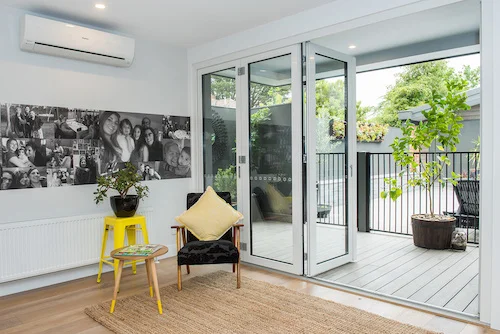
Bi-fold doors (also known as bi-folding or folding-sliding doors) are made up of multiple panels that fold against each other accordion-style and stack to one or both sides of the opening. When fully open, they create a wide, unobstructed aperture that essentially removes the wall between your indoor and outdoor spaces.
They’re a popular choice for alfresco dining areas, open-plan living extensions, and anywhere you want maximum impact. If you’re researching the full range of configurations and specifications available, our uPVC bi-fold doors guide covers everything in detail
What are sliding doors?
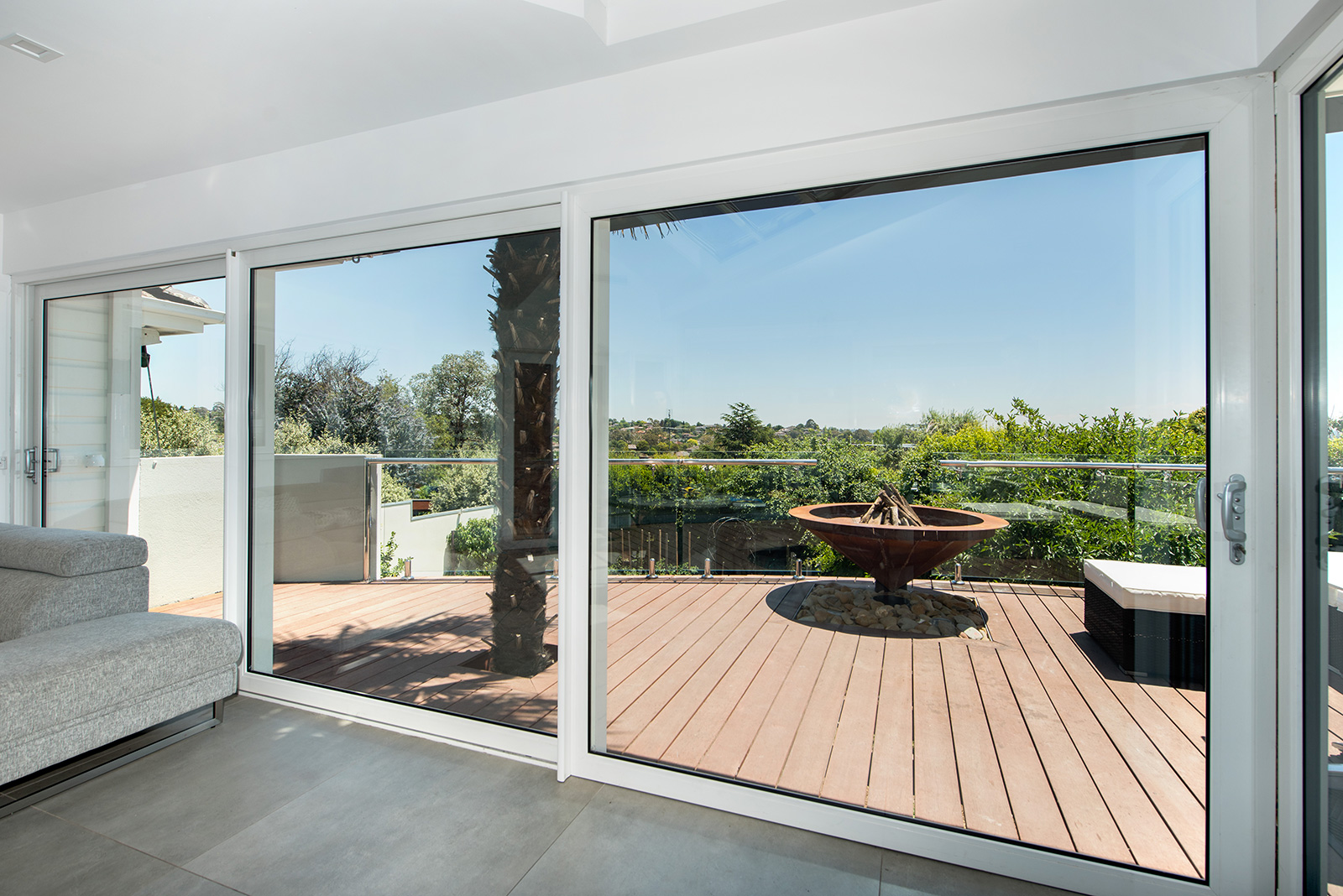
Sliding doors operate on a track system, with one or more panels gliding horizontally past each other or into a wall cavity. They offer a clean, minimal aesthetic and work exceptionally well where space is at a premium – there’s no swinging or stacking to account for in the room itself.
They’ve long been a staple of Australian home design and continue to evolve in terms of performance and frame technology. Our uPVC sliding doors range covers the options available for modern homes.
Bi-fold doors vs sliding doors comparison
Ultimately, the correct decision comes down to evaluating specific lifestyle needs, such as a preference for ventilation styles or for child safety.
| Feature | Bi-fold doors | Sliding doors |
| Opening width | Up to 90% clear opening when fully stacked | Typically 50% clear opening (improves with multi-panel systems) |
| Floor space required | Panel stack beside opening (30-60cm deep) | No stack required – panels slide behind each other |
| Best suited for | Wide openings, entertaining spaces, open-plan living | Narrower openings, high-traffic areas, bedrooms |
| Everyday ease of use | More steps to fully open and close | Simple push-pull action, quick and easy |
| Thermal performance | Excellent in uPVC with quality seals and double glazing | Excellent in uPVC with quality seals and double glazing |
| Aesthetics | Dramatic architectural statement | Clean, understated profile |
| Maintenance | More moving parts – periodic lubrication recommended | Track needs to be kept clear of debris |
| Cost | Higher upfront investment due to panels and hardware | Generally more budget-friendly starting point |
How do bi-fold doors and sliding doors compare?
Space and opening width
This is often the first consideration, and the two door types behave quite differently here.
Bi-fold doors can open up almost the entire width of an aperture – some configurations achieve up to 90% clear opening, depending on panel count and configuration. If you want to genuinely merge inside with outside, bi-folds deliver that feeling in a way that’s hard to match.
Sliding doors, by contrast, will always leave some panels in place – a standard two-panel sliding door gives you roughly 50% of the opening as clear access. Wider multi-panel sliding systems can improve on this, and lift-and-slide or smart-slide mechanisms offer impressive performance for larger openings.
Neither is better in isolation – it depends on how you intend to use the space and how important that full-open feeling is to you.
Floor space and practicality
One of sliding doors’ quietest advantages is what they don’t require. Because the panels don’t swing out into the room or fold into a stack beside the opening, you have complete freedom in how you arrange furniture right up to the door.
Bi-fold doors, when open, create a panel stack at the side (or sides) of the opening. Depending on the configuration, this stack can be 30–60cm deep – worth factoring in if you have a narrow deck or a tight room layout.
For homes where practicality and ease of use are priorities – especially where children, older residents, or high foot traffic are involved – sliding doors are often the more forgiving option day to day.
Thermal performance and weatherproofing
In uPVC, both door types can perform exceptionally well for thermal efficiency and weatherproofing. The material itself – reinforced unplasticised polyvinyl chloride – has naturally low thermal conductivity, meaning frames lose less heat than timber or aluminium alternatives.
What matters more than door type is the quality of the sealing system, the glazing specification, and the hardware. A well-manufactured uPVC bi-fold or sliding door, paired with double glazing, will deliver strong energy performance. If thermal efficiency is a priority, we’d encourage you to look at our broader guide to uPVC sliding doors which covers performance in more depth.
Aesthetics and design flexibility
Both door types offer considerable design flexibility in uPVC. Slim sightlines are available across both ranges, maximising the glass area and keeping the look contemporary. Colour options are extensive – from classic white to anthracite grey, heritage tones, and dual-colour finishes (different colours inside and out).
Bi-fold doors tend to create a more dramatic, architectural statement. The folded panels when open have become synonymous with a certain kind of modern Australian renovation. Sliding doors carry a cleaner, more understated profile – they recede into the background visually, which suits minimalist and contemporary styles particularly well.
If your priority is kerb appeal and the “wow factor” when entertaining, bi-folds are often the choice. If you prefer the door to complement the architecture rather than lead it, sliding doors are a natural fit.
Maintenance and longevity
uPVC requires minimal maintenance regardless of door type. Neither bi-fold nor sliding doors in uPVC will rot, warp, or require repainting – unlike timber equivalents. A wipe-down with soapy water is typically all that’s needed to keep frames looking their best.
The main difference is in the mechanism. Bi-fold doors have more moving parts – hinges, pivot points, and folding hardware – that benefit from periodic lubrication. Sliding doors operate on a track system that can collect debris over time and should be kept clear to ensure smooth operation.
Both, when installed correctly with quality hardware, are designed to last decades. Our post on how long uPVC windows and doors last goes into more detail on lifespan and what to expect over time.
Bi-fold doors vs sliding doors: Cost
Cost is one of the most-searched aspects of this comparison, and it’s worth being straightforward: bi-fold doors are generally more expensive than sliding doors of a comparable size. This is primarily because of the increased number of panels, hinges, and the more complex hardware required for the folding mechanism.
That said, pricing varies significantly depending on:
That said, pricing varies significantly depending on:
- Number of panels – more panels means more cost for either door type
- Opening width – larger apertures require more material and engineering
- Glazing specification – double glazing, acoustic glass, and tinted options all affect price
- Hardware quality – the quality of tracks, locks, and handles varies considerably across suppliers
- Installation complexity – structural work, lintels, and site access all play a role
As a rough guide, uPVC sliding doors tend to be the more budget-friendly starting point, while bi-fold doors represent a larger investment that many homeowners feel is justified by the dramatic transformation they deliver.
Which is better for different types of spaces?
Rather than a blanket recommendation, here’s how the choice often plays out across common scenarios:
Wide, unobstructed openings (4m+): Bi-fold doors shine here. The wider the opening, the more impactful the fully-open configuration becomes. Multi-panel bi-folds for wide apertures create a genuinely transformative connection between rooms.
Narrower openings or tight room layouts: Sliding doors are often more practical. With no panel stack to accommodate, they work well where space is limited – both inside and on the deck or patio outside.
High-traffic areas: Sliding doors are typically easier to operate for everyday use – a simple push-pull action with no folding mechanism. If a door will be opened and closed many times a day, sliding systems handle that frequency comfortably.
Open-plan entertaining spaces: Bi-folds are often the preferred choice for connecting an open-plan kitchen or living area to an alfresco. The full opening creates a seamless indoor-outdoor flow that suits entertaining well.
Bedrooms or quieter spaces: Sliding doors tend to suit bedroom applications – they operate quietly, have a lower visual footprint, and are straightforward to use at any hour.
Bi-fold or sliding doors – what should you consider before you decide?
Before you settle on a direction, these are the questions worth working through:
- How wide is your opening? Wider openings tend to favour bi-folds; narrower ones often suit sliding doors.
- How much space do you have beside the opening? Bi-fold panel stacks need clearance – measure carefully.
- How often will the door be fully opened? If it’s mostly decorative or occasional, bi-folds make sense. Daily heavy use suits sliding systems.
- What’s your budget? Be honest about the range you’re working with – both types can deliver excellent results at their respective price points.
- What aesthetic are you after? A dramatic architectural feature, or a clean backdrop that lets the view speak for itself?
- What’s the priority – maximum opening or minimum maintenance? Both are low-maintenance in uPVC, but the mechanisms differ.
There’s no wrong answer here. The decision that feels obvious once you’ve run through these questions is usually the right one.
Explore Vue’s uPVC bi-fold and sliding doors
Still weighing it up? Get in touch with our team – we’re happy to talk through your specific opening, layout, and budget, and help you find the right fit.
Vue Windows specialises in a range of uPVC door styles, from sliding and bi-fold doors, to entry & french and smart slide doors
When you choose Vue Windows, you benefit from:
- Superior energy efficiency
- Low-maintenance design
- Custom colours and styles
- Long-lasting durability
- Expert local installation across Melbourne
Ready to upgrade your home? Contact Vue Windows today for a consultation or quote to discover how our premium uPVC doors can transform your living space.